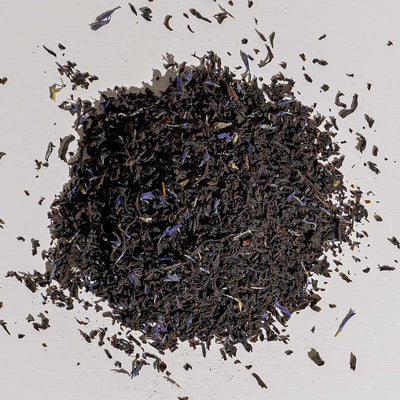
What is Earl Grey tea? Earl Grey is a black tea flavored with oil of bergamot, a fragrant citrus fruit, which gives it a bright, floral, citrusy aroma. It is one of the best-known flavored teas in the world and is named after Charles Grey, the 2nd Earl Grey, who was British prime minister in the 1830s. Classic Earl Grey uses a black tea base, so it has caffeine, but you’ll also find Earl Grey made with green tea, white tea or caffeine-free rooibos. This guide is for anyone curious about this classic tea, from first-time drinkers to tea lovers choosing their next tin. Below, you’ll find what Earl Grey tea is, what bergamot is, the history and origin story behind the name, the main types of Earl Grey and how to brew and enjoy it. If you already know you love it, our picks of the best Earl Grey teas compare the blends worth trying.
A classic Earl Grey, a twist on it and a caffeine-free version:

Beach House Earl Grey Black Tea
Classic Earl Grey: organic black tea and natural oil of bergamot, 2 oz

Beach House River City Grey Black Tea
Earl Grey with rose petals, lemongrass and cloves, 2 oz

Free gift: on a first order, add $25 of Beach House teas and a free Beach House gift is added to your cart. How it works
Not sure what to pick? Take our 6-question tea quiz, or see our best Earl Grey teas.
What Is Earl Grey Tea?
Earl Grey is a flavored tea, not a separate kind of tea plant. It starts with tea leaves from Camellia sinensis, the same plant behind black, green, white and oolong tea, and adds bergamot. Most Earl Grey uses a black tea base. Tea makers often choose Chinese black teas such as Keemun, or Indian and Ceylon black teas, depending on how bold they want the cup to be. A Chinese black tea base gives a smoother, slightly smoky Earl Grey; Assam makes it malty and strong; Ceylon keeps it bright and brisk. Bergamot also pairs well with lighter teas, so some tea makers flavor green tea, white tea or oolong the same way; a green tea Earl Grey has a gentler, grassier flavor than the black tea version.

The citrus is added in one of two ways. Most blends spray or mix natural oil of bergamot, or a flavoring, onto the black tea leaves; some also add dried bergamot peel. Many Earl Grey teas include blue cornflower petals as well, mostly for color. The result is a tea blend in which the citrus aroma hits first and the tea flavor follows: bright, floral flavors on top and a robust black tea taste underneath.
So, is Earl Grey a black tea? Usually, yes: classic Earl Grey is black tea plus bergamot, and our comparison of black tea vs Earl Grey goes into the differences. That black tea base also means caffeine: a cup of Earl Grey has about 40–70 mg per 8 oz, like other black teas; our guide to whether Earl Grey has caffeine has the details. As for the flavor, expect citrus and floral notes over a robust tea, and see what Earl Grey tea tastes like for a full tasting guide.
What Is Bergamot?
Bergamot (Citrus bergamia) is a small citrus fruit about the size of an orange, with a bumpy rind that turns from green to yellow as it ripens. The flesh is sour and bitter, so the fruit is rarely eaten fresh. What makes it valuable is the rind: it holds a fragrant essential oil with a floral, slightly spicy citrus scent, somewhere between lemon, orange and grapefruit.

Most of the world’s bergamot is grown along the coast of Calabria, in southern Italy. The oil is cold-pressed from the rind, and it is prized well beyond tea: perfumers have used bergamot in colognes and fragrances for centuries. In tea, natural bergamot oil gives a rounder, more lifelike citrus aroma, while cheaper blends may rely on bergamot flavoring. If the ingredient list says “natural oil of bergamot,” that is the real thing.
Don’t confuse the fruit with the bergamot herb. Wild bergamot, or bee balm (Monarda), is an unrelated plant in the mint family that happens to share the name because its leaves smell a little similar. Earl Grey is flavored with the citrus fruit, or with a flavoring made to taste like it.
The History of Earl Grey Tea
Earl Grey tea is named after Charles Grey, the 2nd Earl Grey, who served as British prime minister from 1830 to 1834 and is best known for the Reform Act of 1832. Earl Grey is a title rather than a surname: Charles Grey inherited it from his father in 1807. How his name ended up on a bergamot-scented tea is less clear, and the origin story comes in several versions:
- The Chinese gift. The most famous legend says a Chinese official gave Grey the recipe as thanks after one of Grey’s men saved his son from drowning. Grey never traveled to China, and historians treat the story as a legend.
- The water at Howick. Another story, linked to Howick Hall, the Grey family home in Northumberland, says the blend was made to suit the local water, which is rich in lime, and that Lady Grey later served it to guests in London.
- Rival claims. Two London tea firms, Twinings and Jacksons of Piccadilly, each claimed to hold the original recipe.
What is clearer is that tea flavored with bergamot was known in England by the 1820s, when it was sometimes used to make ordinary tea smell like more expensive Chinese teas, and London merchants were advertising “Earl Grey’s Mixture” by the 1880s, decades after Grey left office. Chinese black teas were the usual base at the time, and Chinese Keemun is still a classic choice for Earl Grey. From there, Earl Grey became one of the most popular tea blends in Britain and around the world, and it is now one of the most recognized flavored teas on store shelves.
Types of Earl Grey Tea
Once you know the classic flavor, it’s easy to find a version of Earl Grey for every taste, and the extra flavors range from vanilla to rose. These are the main types:
| Type | What’s different |
|---|---|
| Classic Earl Grey | Black tea and bergamot, sometimes with blue cornflower petals |
| Earl Grey Cream | Adds vanilla to the blend for a smooth, creamy cup |
| Lady Grey | Adds orange and lemon peel for a lighter, brighter citrus flavor |
| French Earl Grey | Adds rose petals for a floral note |
| Russian Earl Grey | Adds citrus peel and sometimes lemongrass |
| Lavender Earl Grey | Adds lavender flowers |
| Green tea, white tea or oolong Earl Grey | Bergamot on a lighter tea base; it still has caffeine, and the amount depends on the tea and how you brew it |
| Rooibos Earl Grey | Bergamot on rooibos: caffeine free |
| Decaf Earl Grey | Decaffeinated black tea: about 2–5 mg of caffeine per cup |
If you’re choosing between Earl Grey and English Breakfast, the short version is that Earl Grey is a flavored, aromatic black tea while English Breakfast is an unflavored, malty black tea blend; our comparison of Earl Grey vs English Breakfast covers both in detail. For more on the black teas used as a base, see our guide to types of black tea.
How to Choose a Good Earl Grey
Earl Grey teas vary a lot, from bags with a faint citrus scent to loose leaf tea with a strong bergamot aroma. A few things to look for when you choose one:
- Natural oil of bergamot. It gives a rounder, more natural citrus flavor than a generic “bergamot flavor.” The ingredient list will tell you which one a tea uses.
- The base tea. Chinese black tea makes a smoother cup, Assam a bolder one that suits milk, and Ceylon a brighter one. If you want a lighter flavor, try a green tea Earl Grey; for no caffeine at all, choose a rooibos Earl Grey.
- Loose leaf or tea bags. Loose leaf usually has larger leaves and a fresher aroma; tea bags are quicker and easier to take to work.
- Freshness. Bergamot oil fades over time, so buy amounts you’ll finish within a few months and store them in an airtight tin away from light, heat and strong smells.
- Extras. Cornflower petals are mostly for looks; vanilla, rose, lavender or citrus peel change the flavor, so pick them only if you want that twist.
Not sure where to start? A classic loose leaf Earl Grey with natural bergamot oil is the best way to learn the flavor before trying variations. Our best Earl Grey teas guide compares our favorite blends side by side.
How to Brew Earl Grey Tea
Classic Earl Grey on a black tea base is brewed like other black teas:
- Measure. Use 1 teaspoon of loose Earl Grey, or one tea bag, per 8 oz cup.
- Heat the water. Bring fresh water to 200–212°F, just off the boil.
- Steep. Steep for 3–5 minutes, then remove the leaves or tea bag. Three minutes keeps the citrus up front; five gives a stronger brew.
- Finish as you like. Drink it plain, or add milk, honey or a little sugar.
For a green tea or white tea Earl Grey, use cooler water, around 175–185°F, and steep for 2–3 minutes; a rooibos Earl Grey takes water at 205–212°F and 4–6 minutes. Follow the package if it gives its own instructions.
Steeping a black tea Earl Grey much longer than 5 minutes can make it bitter, as the tannins in the black tea start to overpower the citrus flavor. Loose leaf Earl Grey usually gives a fuller cup than tea bags, and a tin with a tight lid keeps the bergamot aroma fresh longer.
Ways to Enjoy Earl Grey
Earl Grey is one of the most versatile teas to drink and to cook with:
- With milk. The black tea base takes milk well; a splash softens the citrus and makes the cup rounder.
- London Fog. An Earl Grey latte: strong Earl Grey topped with steamed milk and a little vanilla syrup. To make a London Fog at home, brew a double-strength cup, then add frothed milk and vanilla to taste. A London Fog made with rooibos Earl Grey is a caffeine-free version for the evening.
- Iced Earl Grey. Brew it double strength and pour it over ice, or cold steep the leaves in the fridge for 6–12 hours; see can you steep tea in cold water for the method.
- In baking. Earl Grey flavor works in cakes, cookies, shortbread and scones: steep the leaves in warm milk or butter, or grind them finely into the dough.

Earl Grey has a place in pop culture too: Captain Picard’s order of “Tea, Earl Grey, hot” in Star Trek: The Next Generation made it one of the best-known teas on television. However you take it, Earl Grey is a tea that works from a morning cup with milk to an afternoon iced glass.
FAQs
Can you put milk in Earl Grey tea?
Yes. Earl Grey is usually a black tea, so it takes milk well, and many people drink it that way. Add the milk after the tea has steeped, and start with a small splash so the bergamot still comes through. If you prefer lemon, leave the milk out, because lemon can curdle it.
Is there a caffeine-free Earl Grey?
Yes. Rooibos Earl Grey pairs bergamot with rooibos instead of tea leaves, so it has no caffeine. Decaf Earl Grey is made with decaffeinated black tea and still has a little, about 2–5 mg per cup, compared with about 40–70 mg in a regular cup. A green tea Earl Grey is not caffeine free either.
Who was Earl Grey named after?
Earl Grey tea is named after Charles Grey, the 2nd Earl Grey, who was British prime minister from 1830 to 1834. How his name ended up on a bergamot-scented tea is disputed, and the most famous origin stories are not proven.
How long should you steep Earl Grey tea?
Steep a classic black tea Earl Grey for 3–5 minutes in water at 200–212°F. Three minutes gives a lighter cup with more citrus up front; five minutes gives a stronger, more robust cup that stands up to milk. A green tea Earl Grey needs cooler water, around 175–185°F, and 2–3 minutes.
Final Thoughts
In short, Earl Grey tea is black tea flavored with bergamot, a citrus fruit grown mostly in southern Italy, and it is named after Charles Grey, the 2nd Earl Grey. Its exact origin story is disputed, but its appeal isn’t: the bright citrus aroma, the robust tea underneath and the many versions, from Earl Grey Cream to rooibos Earl Grey, make it a classic worth knowing.
Ready to find your favorite? See our picks of the best Earl Grey teas, or browse our Earl Grey tea collection for classic, cream, lavender and caffeine-free blends.
Behind the Cup

More about Earl Grey
- Best Earl Grey teasBuying guide
- Does Earl Grey Tea Have Caffeine?
- Earl Grey vs English Breakfast
- What Does Earl Grey Tea Taste Like?
- Black Tea vs Earl Grey: Which Tea Fits Your Daily Routine?
- Lady Grey vs Earl Grey
More black teas: Best English Breakfast teas · Best black teas · Best Darjeeling teas · Best Ceylon teas · Best Assam teas